 Pancakeswap
 task matching across swaps, orders and liquidity positions
Pancakeswap supports several onchain jobs, and each one needs a different combination of wallet state, token inputs, limits and completion evidence. An immediate swap fits a known input and acceptable quoted output. A target-price order fits a price condition without a fixed completion time. Liquidity provision fits an inventory commitment whose value and fee activity can change. Choose the intended result first, identify any missing prerequisites and define the balance, position or order state that confirms completion.
An executable quote turns an input into a bounded output
An immediate swap fits a task with one input asset, one desired output and an acceptable execution boundary. The quote should identify the input amount, estimated output, minimum received amount, route, trading fee and price impact. The wallet also needs the correct network, the input balance and enough of the network gas asset to submit the required transactions.
The estimated output describes the route at quotation time, while the minimum received amount defines the lower execution boundary. Those figures serve different purposes. A strong estimate does not rescue a minimum output below the reader's acceptable floor. Before signing, refresh an old quote and compare the bound with the intended result. The job ends when the confirmed transaction produces the expected output balance, not when the interface first displays an estimate.
Routing preferences determine the quote's path
Routing settings change how an immediate swap can reach the same desired output. A smart route can split one swap across pools or pass through intermediate tokens when those paths improve the quoted execution. Restricting multihop or split routing can simplify the path, yet it may reduce the available liquidity or worsen the output. Compare routes with the same input amount, network and quote time so the fee, price impact and minimum output remain meaningful.
Order types exchange immediate settlement for execution conditions
An order mode fits when price or pacing matters more than receiving the output immediately. Availability can depend on the selected network, tokens and order implementation, so the displayed order controls define the usable path.
Target-price execution
A target-price order waits for its stated price condition. Reaching the target can make the order eligible for execution, but it does not establish a completion time. Available liquidity, fill rules and fees can still affect whether the order fills. The useful evidence is an open, filled, partially filled, cancelled or expired state paired with the resulting wallet balance.
Time-divided execution
A time-weighted order divides a total input across scheduled trades. More divisions reduce each trade's size, but they also create more executions and potentially more aggregate network cost. A price limit can stop individual portions from filling when the available price falls outside the bound. Execution ends after the intended portions fill or the order is cancelled or expires. Confirm the final fill and remaining balance before closing the task.
Liquidity provision replaces a single output with an owned position
Providing liquidity fits a different outcome from swapping: the wallet contributes pool assets and receives evidence of a position. The required inputs depend on the pool design. A paired deposit commonly needs both assets, sufficient balances, any required token approvals and network gas. The quote or preview should show the chosen pool, version, fee setting and deposited amounts before commitment.
The position exposes its owner to changes in the relative quantities of the deposited assets. Trading fees may accrue, but they do not guarantee the position will outperform simply holding the assets. The intended stopping point therefore needs more detail than transaction success. It may be a visible position, collected fees, a partial withdrawal or the return of both underlying assets after closing.
Pool design determines what owners must manage
The pool version determines what the owner must monitor after deposit. Similar token pairs can create positions with different range rules, ownership records and fee handling.
V2 full-range shares
A V2 position supplies liquidity across the available price curve and is represented by fungible liquidity-provider tokens. The wallet's share changes in composition as trades alter pool reserves. Removing liquidity redeems the share for the two underlying assets according to the pool state at withdrawal.
V3 concentrated ranges
V3 lets the owner choose a price range and represents each configured position as a non-fungible token. A concentrated-liquidity position earns trading fees only while the market price remains inside its configured range. Outside that range, the position becomes inactive and its inventory can consist entirely of one asset. The owner must decide whether to wait, withdraw or create a differently configured position.
Infinity pool structures
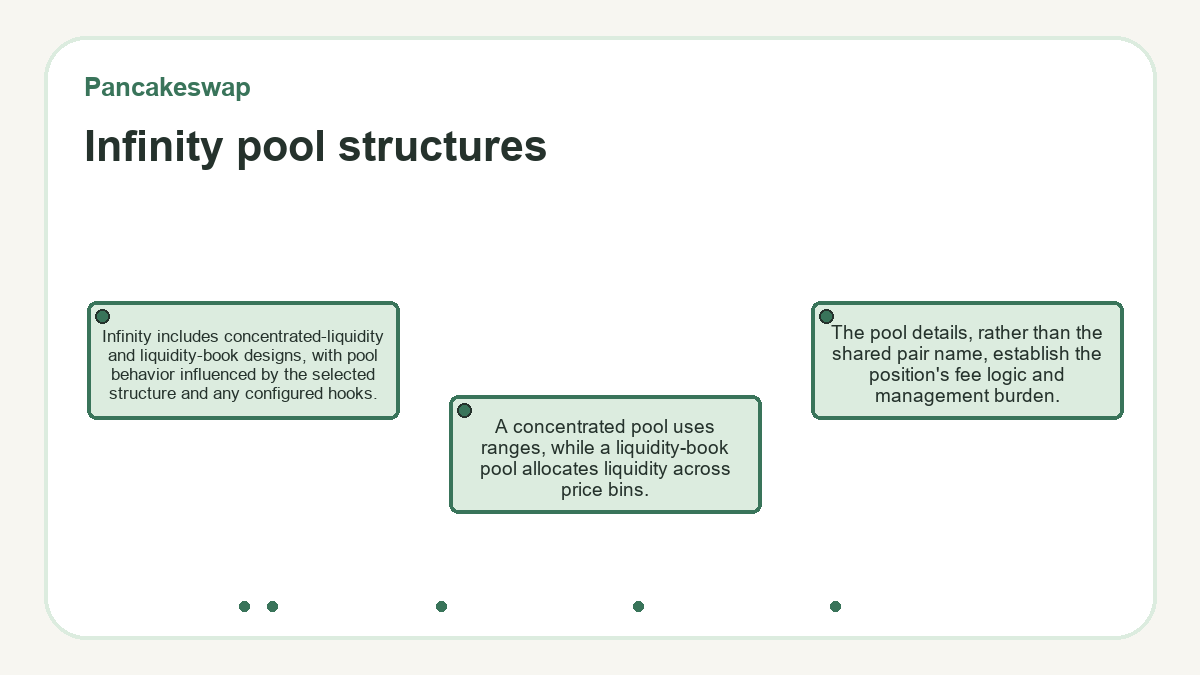
Infinity includes concentrated-liquidity and liquidity-book designs, with pool behavior influenced by the selected structure and any configured hooks. A concentrated pool uses ranges, while a liquidity-book pool allocates liquidity across price bins. The pool details, rather than the shared pair name, establish the position's fee logic and management burden.
Cross-chain routes add a second settlement context
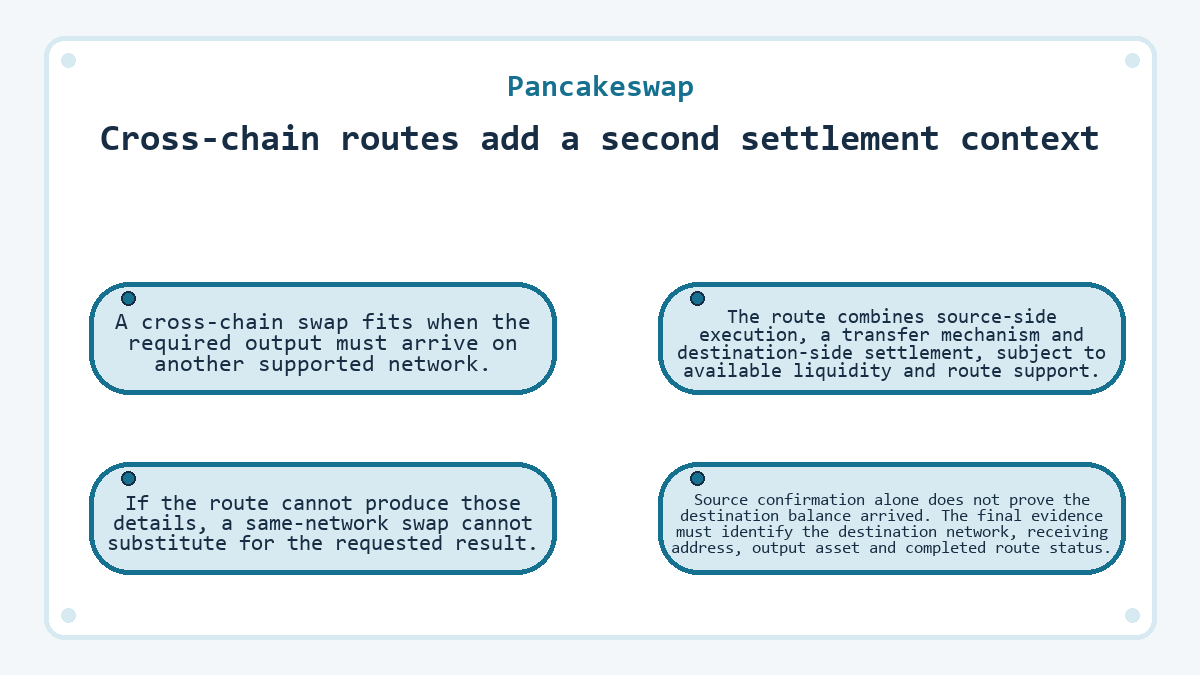
A cross-chain swap fits when the required output must arrive on another supported network. The route combines source-side execution, a transfer mechanism and destination-side settlement, subject to available liquidity and route support. Source confirmation alone does not prove the destination balance arrived. The final evidence must identify the destination network, receiving address, output asset and completed route status. If the route cannot produce those details, a same-network swap cannot substitute for the requested result.
Permission does not prove transaction settlement
Approval, signing and settlement are separate events, even when the interface presents them as one flow. Treating them separately prevents an authorization from being mistaken for a completed task.
Token allowance
On an EVM network, an approval authorizes a specified contract to spend a token up to the allowance recorded by that token contract. It does not execute the later swap or deposit. The relevant evidence includes the token contract, approved spender, allowance amount and network. If a second asset enters a liquidity position, it may require its own authorization.
Action signature
The later wallet request carries the actual swap, order or liquidity instruction. Review the action type, transaction target, amounts and network before signing. Rejecting this request prevents that submission, but it does not automatically remove an earlier confirmed allowance. A completed signature is also not final settlement; the transaction still needs an onchain outcome.
Onchain records reconcile expected and displayed states
A confirmed transaction record is the primary evidence when the interface, wallet token list and expected result disagree. Match the wallet address and network first. Then inspect the transaction status, token transfers, contract interactions and any position or order identifier. A wallet may hold a token balance even when its interface has not added that token to the visible list.
Failure location changes the next action. A request rejected inside the wallet never reached the network. A pending submission may need more time or network-specific handling. A reverted EVM transaction does not complete the requested state changes, although it can consume gas. A successful transaction with an unexpected asset calls for checking the token contract and route details before submitting anything else.
A missing prerequisite changes which action fits
All balances, allowances, quoted outputs and acceptance limits in this worked comparison are hypothetical. A reader wants one output token and starts with 76 units of an input token. The wallet shows an 80-unit allowance for the selected input token and swap spender on the selected network, no network gas balance and no second deposit asset. A refreshed swap quote estimates 73.2 output units, with a minimum of 71.6. The reader's acceptance floor is 72.0.
The immediate-swap action matches the desired result, but two facts stop it. The missing gas balance prevents submission, and the 71.6-unit minimum falls below the 72.0-unit floor. Funding gas would repair only the first condition. Because a refreshed quote could change, the reader still needs a new minimum-output comparison before signing.
A liquidity position uses the same input token but produces the wrong outcome. It also needs network gas and, for the selected paired deposit, a second asset. Its completion evidence would be a position record rather than 72.0 output units. Neither action should be confirmed in this state: the swap misses its bound, while the deposit lacks an input and does not match the stated job.
Exit conditions define when each task is complete
A task ends when its intended outcome appears and any remaining approval, order or position is accounted for. Transaction submission is only an intermediate state.
For a swap, completion means the transaction succeeded and the expected token reached the intended address on the selected network. The actual output should remain within the accepted bound. An unresolved approval or pending transaction does not meet that condition.
For a target-price or time-divided order, an open status means the task continues. A filled state needs the corresponding output balance. Partial execution leaves a remaining amount to monitor or cancel, while cancellation needs confirmation before the order can be considered closed.
For liquidity, the position record proves ownership but not active fee generation or a completed exit. Closing requires the selected amount of liquidity to be removed and the returned assets to appear in the wallet. Before treating the exit as complete, account for any uncollected fees or remaining liquidity.
Cross-chain completion requires destination-side evidence rather than source confirmation alone. The same distinction applies within a V3 position: its non-fungible token proves the position exists, while the configured range determines whether its liquidity is active.
Questions people ask about Pancakeswap
Can one liquidity deposit require two token approvals?
On EVM networks, yes, when both deposited assets are tokens whose spending has not been authorized for the relevant contract. Each approval covers a token, spender and allowance rather than the liquidity pair as a whole. A native gas asset used directly may follow a different path, so the wallet prompts identify the authorizations required for the selected deposit.
Does rejecting a swap signature remove an earlier token approval?
No. Rejecting the later swap request prevents that request from being submitted, but a previously confirmed allowance remains recorded by the token contract. Removing or reducing it requires a separate allowance change through a compatible wallet or approval-management tool on the same network.
Can the output token arrive even if my wallet does not list it?
Yes. A token balance can exist onchain before the wallet interface displays that token. Confirm the network, receiving address and exact asset identifier in the transaction record. Only then add the verified asset to the wallet display, since a matching name or ticker does not establish identity.
Is a refreshed quote required after changing wallet networks?
Yes. A quote belongs to a specific network context, including its pools, asset identifiers, balances and gas asset. Changing networks can invalidate every one of those inputs. Select the intended network first, confirm the assets again and request a fresh route before considering any signature.
Which evidence shows a target-price order is still waiting?
An open or pending order state, paired with no completed fill record, shows the condition has not produced the intended output. Interface data can lag, so reconcile the order identifier with its onchain state and wallet transfers. A reached market price alone does not prove execution.